Thursday, January 15, 2009

Requiem Mass for Father Richard John Neuhaus - Some Observations


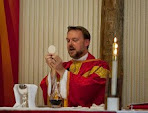
Father Richard John Neuhaus was received into the presence of his Holy Triune God Thursday, January 8, 2009. A requiem mass was celebrated in his memory at Immaculate Conception Parish on 14th Street in New York City at 10am on Tuesday, January 13th, 2009.
Father Neuhaus was a great man of faith, a great intellect, and a great communicator. He was a prolific writer, most notably as Editor in Chief of First Things, and an astute observer and commentator on culture, society, politics, ethics, morality, and religion.
Because Father Neuhaus was baptized in the Name of the Triune God into Jesus’ death and resurrection and because he thus believed I, perhaps unlike his own brothers and sisters of the Roman Catholic faith, have no doubt or uncertainty about His eternal presence before his Creator, Redeemer, and Sanctifier in Zion, nor is he in need or want of any further purification for his sins beyond the all-atoning sacrifice of his Lord and Savior Jesus upon the cross.
I attended the requiem mass on Tuesday. The following are some of my observations.
Immaculate Conception Parish holds, I’m guessing, approximately 400-500 people. The church was filled to standing room only, in the back of the church and in the side aisles. Incense permeated the space and was used periodically throughout the service, something I was most thankful for since the space was so crowded and most attendees had their winter coats and scarves on throughout the hour and forty-five minute service. The music was very good – hymns, choral arrangements, strings (I believe), and a fine organ and organist – (unfortunately, I did not acquire a worship bulletin); a few of the pieces I remember include: O Sons and Daughters of the King, Ave Verum Corpus, Jesu, Joy of Man’s Desiring, The Church’s One Foundation. The music in the mass itself I take to be fairly standard Vatican II Roman Catholic arrangements. Many of the propers and the ordinaries were sung responsively as the congregation was led by a female cantor. My overall opinion of the music is that it was good, tasteful, appropriate, better than I expect from Vat II RC, but somewhat less than I had hoped for at the requiem mass of such a man as R. J. Neuhaus.
Turning to the service itself and what was said about Neuhaus I report the following: I was hopeful that given Neuhaus’ Lutheran pedigree (first LCMS, then ELCA) the Gospel would predominate throughout. I am happy to say that the Gospel was often proclaimed strongly, but that also, at times, it was considerably tarnished by the uncertainty and doubt that absolutely all of Father Neuhaus’ sins had been purged away. One of the first prayers, I believe, (please pardon my ignorance of RC Requiem Mass Liturgy and the fact that as I write this I do not have access to my Liturgy), was to the BVM and saints to forgive Father Neuhaus for his remaining sins. The homilist, D’Souza (sp.?) (possibly a contributor to First Things?), gave a fine homily, very strongly Gospel oriented at times, personal, endearing, humorous, etc., however, at least once, particularly at the very beginning, brought up the bugaboo of uncertainty. I believe the first words out of his mouth were something like, “May whatever of Richard’s sins that remain be quickly purified…”. Please do not think that I am criticizing Roman Catholics for being, well, Roman Catholic; it’s simply that, given Neuhaus’ history, and the latent Lutheranism that for no good reason I believe still resided in him, I had hoped for better. I suppose that I imagined that Neuhaus had planned his funeral, what would be sung, said, performed, etc., well in advance of his death; however, I feel that he may have expressed only minimal wishes and simply submitted himself to the liturgy, practices, and doctrines of the church that he had submitted himself to as priest and in the parish in which he had most recently served God’s people. The readings included standard funeral lections: Psalm 23 (sung/chanted responsively; Isaiah 25:6-9; Romans 6:3-11; John 11:21-27. In the homily D’Souza singled out the word “feast” in the Isaiah passage making the point that the lections were from the RSV, as Neuhaus had been most vocal in his opposition to the RC approved New American Bible translation. So, while in the RSV, the word “feast” is used in description of the goings on in the heavenly Zion, the homilist stated that in the Vulgate the word convivium is used. Convivium means something like “sharing life together”. Convivium was a word that Neuhaus liked very much and used particularly to describe the gatherings he would have at his Manhattan apartment with literati, scholars, theologians, etc., and just plain ol’ good friends. These conviviums apparently included the consumption and enjoyment of fine scotch and cigars. I really enjoyed this idea of convivium, translated as feast in most translations, and found myself contemplating this word in regard to the Eucharistic feast and the “sharing life together” that the Christian assembly enjoys as they partake together of He who is Life incarnate. This alone was worth the trip to Manhattan on a Tuesday morning.
The Eucharistic liturgy was permeated with sacrificial language and action. I will make no further comment on this – it was a Roman Catholic mass, what do you expect?
Who was there? It’s always fun to see who’s present at an event like this. Of people I know I saw Rev. David Benke (Atlantic District President – LCMS), Rev. Daniel Grams (we had planned to meet at the church), Rev. Dien Ashley Taylor, Rev. Paul Sauer. People I kind of know, or now know: Rev. Joel Elowsky. People I don’t know, but know of: Rev. John Nunes, Senator (former) Rick Santorum. Edward Cardinal Eagan was at the Vatican and could not attend. A letter from Cardinal Eagan was read near the end of the service. At least four, maybe five, bishops were present and a host of priests. I thought it was interesting that during the consecration all the priests moved their hands toward the bread and the wine and spoke together the words of institution. That’s about it, I’m not much of a gad-about or glad-hander.
Dan and I slipped out right at the end of the service to avoid being trapped in the church for a long time (we were right near the door in the back and both of us had to get back to our parishes for meetings, classes, and such). This proved to be fortuitous in that we were able to witness Father Neuhaus’ casket being borne out of the church on the shoulders of, I believe, eight strong men (I’d never seen a casket carried in that manner), and the impressive procession of bishops, priests, and altar servants (what a host!). The bells rang loudly, releasing the rooftop pigeons into the Manhattan sky (scenes from many movies were flashing through my mind).
And that was it.
All things considered, the funeral was actually quite simple – humble even, considering the man being remembered, the life celebrated. I feel that God was glorified, even if that glory was tainted by human sin and imperfection – but when isn’t it? Ok, you Lutherans who might be offended by my statements – I’m just being honest about my observations and my feelings about them. I’m a pilgrim and a neophyte, even as an undershepherd. I am working out my own salvation with fear and trembling, chewing on the meat and the mystery of our God who is love. I make no pretense of having everything worked out and I can take, and welcome, my brothers and sisters to show me where I am wrong – but speak the truth in love, please. Roman Catholics, I am not suggesting in any way that the disagreements we have in doctrine, and in practice, are insignificant, nor that the blending or tarnishing of the Gospel and the glory that is due only to God are acceptable, however, I am heartened that perhaps much more of the Gospel is proclaimed in the RCC than I may have surmised.
All being said, a very inspiring and courageous man has been taken from the valley in which we dwell, and he will be missed. And I cannot help but believe that he has joined the eternal convivium of saints and angels with the Father and the Son and the Holy Spirit on Mt. Zion.
Blessed are they that die in the Lord (period).

Wednesday, November 26, 2008

The Church Is An Article of Faith

From today's Treasury of Daily Prayer writing by Martin Luther:

This article, "I believe in the holy Christian Church," is as much an article of faith as the rest. This is why natural reason cannot recognize it, even if it puts on all its glasses. The devil can cover it over with offenses and divisions, so that you have to take offense at it. God too can conceal it behind faults and shortcomings of all kinds, so that you necessarily become a fool and pass false judgment on it. Christendom will not be known by sight, but by faith. And faith has to do with things not seen, Hebrews 11[:1]. Christendom joins with her Lord in the song, "Blessed is he who takes no offense at me" [Matt. 11:6]. A Christian is even hidden from himself; he does not see his holiness and virtue, but sees in himself nothing but unholiness and vice. And you, stupid know-it-all, would behold Christendom with your blind reason and unclean eyes!

In a word, our holiness is in heaven, where Christ is; and not in the world, before men's eyes, like goods in the market place. Therefore let there be offenses, divisions, heresies, and faults; let them do what they can! If only the word of the gospel remains pure among us, and we love and cherish it, we shall not doubt that Christ is with us, even when things are at their worst. As we see here in this book, that through and beyond all plagues, beasts, and evil angels Christ is nonetheless with his saints, and wins the final victory.

Monday, October 20, 2008

The Birth of Post Modernism

The following post from Mr. Christopher Orr's Blog - Orrologion describes adequately and succinctly the philosophy that gave birth to literary criticism / theory and ultimately post modernism. The text is an excerpt from "The Death of Theory" by Michael Cook, an article appearing in Salvo magazine.

Literary Theory (always with a capital T, like the G in God)

...Since the 1980s, literary Theory (always written with a capital T, like the G in God) has captured English department after English department in universities throughout the English-speaking world....

Theory resists definition. It is not monolithic but fissured and fractured into scores of squabbling schools. But here are ideas that nearly all of them share:

  • All reality is constructed. That is, since we cannot, with any certainty, know what exists outside our own experience, we cope by constructing frameworks that we project upon reality. Consequently, a text does not contain the author’s meaning; it merely reflects the reader’s prejudices.
  • There is no such thing as truth; all opinions are relative. Living in a world with no fixed boundaries, no absolute definitions, and no ultimate truths could be a fearful burden. The ingenuity and playfulness of Theory teaches us to cope.
  • The job of the reader-critic is to identify the prejudices inherent in a text. The task of analyzing a text in this way is called "deconstruction." The critic’s job is to dismantle it and show what it really means—which may be a far cry from the author’s intention.
  • Everything is a text, from Shakespeare and the Bible to "South Park" and Harry Potter to billboards in Las Vegas and the New York skyline. One of the best-known shibboleths of Theory is the French phrase "il n'y a pas de hors-texte": there is nothing outside of the text.
  • Theory’s usefulness is not exhausted by literature. Since everything is a text, it can be deployed to analyze everything in our culture. Ultimately, it is a political commitment.
  • The author’s intention is irrelevant. In its most radical form, Theory proclaims the death of the author. Persons literally disappear, becoming merely relations of intersecting texts in a vast cultural conversation. Most theory is resolutely anti-humanist.
  • No doubt the accuracy of my account would be described as bumptious ignorance by an academic Theorist. But it’s close enough, especially for a theory in which it is axiomatic that there are no definitions.

The roots of Theory stretch back to Friedrich Nietzsche, the German philosopher who demolished the stifling rationalism of great 18th- and 19th-century thinkers like Kant, Mill, and Hegel. He defied what he regarded as their smug confidence that all of reality could be ordered and grasped by the human mind and asserted that there are no truths, just interpretations. "Truths are illusions which we have forgotten are illusions, worn-out metaphors now impotent to stir the senses, coins which have lost their faces and are considered now as metal rather than currency," he wrote.

Thursday, October 16, 2008

John Rosemond's Bill of Rights for Children


  1. Because it is the most character-building, two-letter word in the English language, children have the right to hear their parents say "NO" at least three times a day.
  2. Children have the right to find out early in their lives that their parents don't exist to make them happy, but to offer them the opportunity to learn the skills they - children - will need to eventually make themselves happy.
  3. Children have a right to scream all they want over the decisions their parents make, albeit their parents have the right to confine said screaming to certain areas of their homes.
  4. Children have the right to find out early that their parents care deeply for them, but don't give a hoot what their children think about them at any given moment in time.
  5. Because it is the truth, the whole truth, and nothing but the truth, children have the right to hear their parents say "Because I said so" on a regular and frequent basis.
  6. Because it is the most character-building activity a child can engage in, children have the right to share significantly in the doing of household chores.
  7. Every child has the right to discover early in life that he isn't the center of the universe (or his family or his parents' lives), that he isn't a big fish in a small pond, that he isn't the Second Coming, and that he's not ever - in the total scheme of things - very important at all, no one is, so as to prevent him from becoming an insufferable brat.
  8. Children have the right to learn to be grateful for what they receive; therefore, they have the right to receive all of what they truly need and very little of what they simply want.
  9. Children have the right to learn early in their lives that obedience to legitimate authority is not optional, that there are consequences for disobedience, and that said consequences are memorable and, therefore, persuasive.
  10. Every child has the right to parents who love him/her enough to make sure he/she enjoys all of the above rights.
Dr. John Rosemond is a parenting specialist and has a regular column in the Living Section of the Sunday newspaper. His Bill of Rights For Children is taken from his website: www.rosemond.com

Sunday, October 12, 2008

Restoring the Center (Part Two)

Back in August I wrote concerning the problem of risky behavior amongst the youth of our community. At the root of the problem, I posited, lay the breakdown of the traditional family consisting of a husband and a wife (one man and one woman united for life) at the center with children as orbiting satellites. This breakdown has resulted in a fundamental restructuring of the family where the children have become the nucleus and the parents the satellites, with Husband (father) and Wife (mother) existing in entirely separate and increasingly distanced orbits.

This time I intend to focus upon the traditional nucleus – Husband and Wife, mom & dad, the marriage covenant. After God created man and woman He established marriage: And the rib that the LORD God had taken from the man he made into a woman and brought her to the man. Then the man said, “This at last is bone of my bones and flesh of my flesh; she shall be called Woman, because she was taken out of Man.” Therefore a man shall leave his father and his mother and hold fast to his wife, and they shall become one flesh. Genesis 2:22-24. God instituted marriage that a man and a woman could share a one flesh union by each giving of themselves wholly, completely, and unconditionally to the other, thus mirroring God’s selfless and sacrificial love for humanity. God blessed marriage that it should be fruitful and life-giving, evidenced most completely in the birthing and rearing of children. But first comes marriage. And the one flesh union of husband and wife is not to be broken, diminished, or superseded by the subsequent gift of children.

Yet this is exactly what has happened. Child / Family Psychologist John Rosemond often asks attendees at his lectures (typically parents of young children) the following question: Of the time you spent in your family during the past week, what percentage was spent in the role of father or mother versus the percentage you spent in the role of husband or wife? He recounts that “the typical distribution is 90 percent parent versus 10 percent spouse” which, Rosemond says, “is the empirical definition of a child-centered family. […] That’s simply not the way God planned it.” To place children above the marriage covenant is akin to placing the creation above the Creator (which is idolatry; see The First Commandment). A man is Husband before father; a woman is Wife before mother – A Husband and a Wife are one in each other, one flesh. Children simply are not a part of the Husband-Wife relationship. The family instituted by God is marriage-centered, where husband and wife “parent from within” their marriage.

The center, the nucleus, is what holds a family together. The one flesh union of husband and wife is the command center of a family. Husband and wife share a love-bond in Christ that provides the strength, the discipline, and the single-mindedness necessary to parent. Rosemond summarizes, “For a family to work according to God’s design, the husband-wife relationship must be far more active than either parent’s relationship with any child. Husband and wife must be more involved with each other than either of them is with the children. Their lives must be centered on the bond of their marriage, not the children.”

“Nothing makes a child feel more insecure than the feeling that his parents’ marriage is tenuous, that it could fly apart at any second,” observes Rosemond. Rather, a strong marital bond is comforting to children. The consequences of an “inside-out, upside-down, and turned around backward family situation include,” says Rosemond:

· The children lack a model of what being truly married is all about. Therefore, when they grow up, they are likely to either avoid getting married (which more and more young people are doing) – running instead from one “fly by night” relationship to another – or enter into marriages for all the wrong reasons (e.g., sex, status, financial security, to legitimize children), in which case their marriages are likely to fail.

· The children develop a sense of entitlement as regards the disproportionate amount of attention and material things they receive from their parents. They become ever more demanding, disrespectful, petulant, and even outraged at the notion that they should actually lift a finger around the house. As adults, they are likely to bring this same expectation into relationships. Symptomatic of this is the self-centered answer many newly divorced young people give when asked what caused the divorce: “He/she wasn’t meeting my needs.”

· Because the parents are more concerned with having a relationship with than providing leadership to their children, the children do not receive adequate discipline. Behavioral problems develop, almost always involving one or more of the “three Big Ds”: disobedience, disruptiveness, and disrespect. Quite often, however, these parents have their heads so buried in the sands of a fourth “D” – denial – that they do not even see that their children are undisciplined. They think they’re “just being children” while other adults generally think they’re obnoxious.

· When the normal time for emancipation rolls around, the children do not have permission to leave home. Quite simply, a child cannot emancipate him- or her- self easily from the center of the family universe. The center is too cozy. Who would want to leave? Besides, the child in this situation knows that for as long as he can remember, he has been the glue holding his parents together (in psychological terms, this is called codependency). If he leaves, he knows they are likely to divorce.

Being marriage-centered is as important to the healthy rearing of children as being Christ-centered is to a healthy marriage. It is with the love of Christ that a husband and wife love each other; it is with the love of Christ that a husband and wife can be successful parents. This is because God has a blueprint for our lives, an order. The world denies this vehemently, the secular media says that you are ignorant, foolish, and uneducated to believe such, but it is nevertheless the truth. Rosemond states, “If you depart from God’s plan in any area of your life, you will experience more (and more seious) problems than you would have encountered otherwise.” And what Christian family, struggling to be faithful, has not experienced this truth? Further, Rosemond states, “If you adhere to God’s plan in your life, you will still experience sadness, pain, frustration, and heartache (since the Fall, there is no escaping this tribulation), but you will endure and you will eventually come out on top.”

One of the purposes for which God instituted marriage is so that through this covenantal relationship humanity might come to know better their God and the kind of relationship He wants to have with the pinnacle of His creation. The selfless and sacrificial love husband and wife have for each other is to mirror the selfless and sacrificial love of God for humanity. Likewise, the bearing and rearing of children is nothing less than a participation in the ongoing creative activity of God, bringing life and increasing love. Husbands and wives in a one flesh union also mirror their Creator in bringing forth new life. As humanity, the creation, is not above God, the Creator, so children are not above their parents, the marriage unit, one flesh, that is husband and wife.

All of the John Rosemond quotes above are taken from his latest book Parenting by The Book: Biblical wisdom for Raising Your Child (ISBN 1-4165-4484-4). I cannot recommend this book too highly. It is simply fabulous! I encourage you to read it.

Thursday, August 28, 2008

Not Wicked, Just Misunderstood


A couple of weeks ago I had the opportunity to see the musical Wicked on Broadway. I must confess that I’ve always viewed Broadway with a certain degree of suspicion, viewing its productions as dolled-up vehicles for liberal propaganda. I’m sorry to report that my suspicions were, in some ways, confirmed. However, it would be incorrect to label Wicked a mere vehicle, though the play is most definitely the product of post-modern liberal thinking. It blurs the distinction between good and evil (wickedness) and questions (denies) the possibility of truth.

Wicked is the back-story, if you will, to The Wizard of Oz, told from the perspective of the two witches, G(a)linda the Good Witch of the North and Elfaba the Wicked Witch of the West. Anyone who has seen Wizard assumes that the Wicked Witch is wicked, but Wicked begins with the question asked of Glinda “Why does wickedness happen?” to which she replies “That’s a good question; one that many people find confusifying. Are people born wicked, or do they have wickedness thrust upon them?” This is probably the most post-modern question possible because either answer releases the subject from moral accountability. If someone is “born” that way, then how can they be held accountable for that, they had no choice. If “it” was thrust upon them, then they had no choice in that either. So the post-modern experiment goes. Post-modernism assumes that there is no objective, absolute truth, so all we are left with is truth(s) as we perceive it (them) – pure, unabashed relativism.

Wicked is really the story of how Elfaba became known as the Wicked Witch. From the very beginning the opening question is answered – she was born in a certain way, she had no choice. But even with that, there was nothing particularly wicked about Elfaba, she was simply different – she was green. So the other possible answer to the question is given as well, Elfaba had the perception of wickedness thrust upon her by extenuating circumstances. The audience had to conclude that it wasn’t Elfaba’s fault, that she was not morally accountable – she wasn’t wicked, she was just misunderstood.

This is not a new idea in theater or literature. Mary Shelley explored this theme in Frankenstein; Nietzsche exhorted us to move Beyond Good and Evil. What does it mean to be good or evil (wicked)? Who has the objectivity to make that judgment? These are post-modern questions born of the fundamental assumption that there is no objective truth. Now this may be the source of an enjoyable philosophical exchange, but it is also the source of much mischievous chicanery. What is at stake is moral accountability, for according to this worldview there is no standard or rule, and no God, by which actions can be objectively judged. Is homosexuality a sin? How can it be, he was born that way? Is abortion a sin? How can it be, the circumstances were thrust upon her?

Of course, it is a lie, and there is Truth, and His Name is Jesus the Christ – I am the Way and the Truth and the Life (John 14:6). God has spoken in regard to homosexuality, abortion, and all sin. God has clearly delineated between good and evil. He, and His Word is the measure by which all things are judged – He alone is good. The perfect Law of God condemns all so that the perfect grace of God may forgive all in Jesus Christ. We are all wicked and fall short of glory of God, but in Christ Jesus we are all forgiven, restored.

All in all, Wicked was a delightful production – well acted, great set, wonderful music, and an enjoyable and thought-provoking story. But it denies the existence of Truth, so it has embraced the possibility of two lies, therefore existing in the post-modern plain of uncertainty. Perhaps it was born that way? Or was this philosophy thrust upon it? I do not mourn for Wicked, but I will pray for those deceived by its lies.

Friday, August 8, 2008

The Twelfth Sunday after Trinity


(Mark 7:31-37; Romans 10:9-16; Isaiah 29:17-24)

In the Name of the Father and of the + Son and of the Holy Spirit. Amen.

If you listened closely to the Lessons today, if you truly prayed with me the Collect, if you chanted with me the words of the Introit, then you have heard with your ears and you have confessed with your own lips the fundamental ailment of our human race: We are not open to the Word of the Lord to hear it or to speak it, unless the Lord Jesus uses His finger the Holy Spirit to blast away our deafness and to open our mouths to speak His praise.

It is no coincidence then that the opening words of the liturgy for Matins, the traditional morning prayer of the day, come from Psalm 51, the confessional Psalm of King David: O Lord, open my lips, and my mouth will declare Your praise. These are indeed appropriate words to begin the day for if we are to praise the Lord this day, or any day, if we are to glorify Him in word and deed by selflessness, service, and sacrifice, then He is going to have to open our closed lips. Apart from His gracious activity by the Holy Spirit we are like the man in St. Mark’s Gospel, deaf and tongue-tied, unable to hear or to speak.

The lesson the Lord offers us today is perhaps the most difficult for us to hear and to believe, for it says to us that we cannot hear or know the Lord, that we cannot praise His Name unless He opens our ears and looses our tongues. We cannot hear the Lord, we cannot praise the Lord, we cannot know the Lord, let alone choose Him, on our own. To be sure, this is not a new lesson. You have all confessed in the words of the Catechism: I believe that I cannot by my own reason or strength believe in Jesus Christ, my Lord, or come to Him; but the Holy Spirit has called me by the Gospel, enlightened me with His gifts, sanctified and kept me in the true faith. It is the work of the Holy Spirit that calls, gathers, enlightens, and sanctifies, that opens ears and loosens tongues, that creates faith in Jesus our Lord. Not you, not me, not by anyone’s own will and volition.

And that’s what makes this lesson so hard. And that’s what makes this lesson, once learned, so liberating. Honestly, this lesson is what makes one a Lutheran. Faith in Christ Jesus is not a work that you do or a decision that you make. It is the work of the Holy Spirit, the finger of the Lord, given to you as a free and perfect gift. Your ears were closed, He has opened them. Your tongue was tied, He has loosed it. You were unbelieving, He has called you and given you faith. You were spiritually dead, He has raised to you to new life. You could not, would not choose Him, so He chose you and appointed you that you should go and bear fruit.

Why is this lesson so hard for us? Well, as enlightened Americans of the 21st century, we consider ourselves independent. We don’t want to have to depend on anyone for anything. We like to believe that if we study hard and work hard that we’ll be able to get good jobs and earn an honest living, purchase our own home, purchase our own car, put our own food on our own table, etc. That’s essentially the American Dream, right? And, in itself, there’s nothing wrong with that. However, as self-centered, self-serving sinners, what we really want is to be our own god. At the very least, we’d like to think that our faith is the result of our own decision and choice.

How then can learning this lesson, that only by the Holy Spirit can we truly hear the Word of the Lord and speak His praise, indeed, even believe in Him, how can learning this lesson be liberating, even make us Lutheran? Because it restores the proper relationship between Creator and creature, between your Lord and your self. You see it’s nothing less than a First Commandment issue: When God is truly your God, then you can realize and receive what it truly means to be His beloved. And that, my friends, is liberating, for it releases you from the bondage of the Law. Now you can serve the Lord and your neighbor, not in fear and guilt or under compulsion, but in response to His love, mercy, grace, and forgiveness. Now you can truly love God and truly love your neighbor, because your Lord loves you, and it is with His perfect love that you love.

Christian faith begins in passivity – it is the Lord who creates, opens, resurrects by the Holy Spirit. We are as fruitless as soil until the Sower sows His Seed. We are as lifeless as Lazarus until the Lord calls to us with His life-giving Word. But we do not remain lifeless, fruitless, or passive, for He who has chosen us has also appointed us to bear fruit. More often than not, the fruit of the Spirit is not quantifiable or countable, but it is a way of being, a way of life – for it is nothing less than, nothing other than, the life of Christ lived in and through us.

What does this Christian life look like? Well, what does the life of Christ look like? What are the qualities that mark the life of Christ? Are they not mercy, love, compassion, forgiveness, grace, charity, peace, humility, selflessness, sacrifice, and the like? These you have received from the Lord in abundance; these He gives to you even now. Your ears have been opened to hear His Word. Your tongues have been loosed to speak His praise. By His finger the Holy Spirit, through the Word of the Gospel, the Lord calls, enlightens, sanctifies, and keeps you. And He who is the True Vine has appointed you His branches to be fruitful. There is nothing for you to do, but there is something glorious for you to be – for you are a member of the very Body of Christ, His Church, His beloved and you have been called to share His life, His love.

Almighty and merciful God, by Your gift alone Your faithful people render true and laudable service. Help us steadfastly to live in this life according to Your promises and finally attain Your heavenly glory.

In the Name of the Father and of the + Son and of the Holy Spirit. Amen.

Thursday, July 31, 2008

Restoring the Center


The Pawling community was shocked last month by the sudden death of one of its youth, Francis “Frankie” Hughes. Shortly after his death the word began to spread that Frankie died from a heroine overdose. Since then, several arrests of teenagers from our community have been made due to leads discovered in the investigation of Frankie’s death. Today, stunned, parents, teachers, church leaders, town and village boards, and countless others are alarmed, concerned, angry, and afraid. And the questions: How could this have happened? Why are our youth engaging in such risky behavior? What are we going to do to address this? Where did this problem come from? Why didn’t we see it coming?

Some thirty representatives from the above mentioned groups, including myself, met Monday morning (July 28) to discuss this problem. The one hour meeting amounted to little more than an airing of concerns, fears, and frustrations, but it was, nevertheless, the first step towards acknowledging the proverbial elephant in the room. In other words, the problem concerning the risky behavior of our youth is not a new problem and it did not suddenly develop over the course of a few months. And so, there will be another meeting, this time for the entire community, Tuesday, August 12, 7:30pm in the cafeteria of the Pawling Middle School – please plan to be there.

Again, the problem is not a new one and it did not develop in a short period of time. In my opinion, the source of the problem (other than sin!) is the breakdown of the traditional family that began somewhere near the end of the 1950’s. When parents began to be encouraged to refrain from disciplining their children so as not to damage their self-esteem, to never say no, to ask the child’s opinion on decisions traditionally made by the parents (e.g., when to go to bed, what they would like to eat), etc. a fundamental shift in the structure of the family began to occur. No longer were father and mother (husband and wife) the center of the family with the children as satellites (remember the “nuclear family”), but the “nucleus” became replace with the children. Nearly fifty years later, our culture and society has further weakened the family structure with the phenomena of free and easy divorce, single mothers, gay and lesbian civil unions, etc. Further, children now decidedly reign as the center of the family. Particularly it seems in the Northeast, nearly all of the family’s non-working time is dedicated to the felt “needs” of the children. Parents expend countless hours and dollars shuttling their kids to myriad activities and events because they have been convinced, by child family psychologists and by peer pressure that they must do so to build their child’s self-esteem – and, of course, to make sure they have as good or better stuff as all their peers, to ensure their popularity with their peers, and to get them into the right college.

Let me address this boogeyman so-called “self-esteem”. A dictionary definition of self-esteem is “to have a good opinion of oneself.” Now I don’t know about other parents, but I, for one, am pretty certain that my kids were born with a healthy, strong opinion of themselves (or, they developed such rather naturally). Heck, to use Freudian terminology, young children are pure Id, all that they are concerned about is themselves and what serves and pleases them, me, myself, and I. Today parents are supposed to encourage, promote, and strengthen this infantile self-centeredness? Interestingly, there were some older teens present at the July 28 meeting. At one point they were asked what, in their opinion, were the reasons for their peers engaging in risky behavior. Their answer: boredom and – are you ready? – low self-esteem! For nearly fifty years parents have been derided, guilted, and pressured into building their children’s self-esteem and, lo and behold, it hasn’t worked! Youth still feel unfulfilled, there’s still something lacking – what could it be? Give me a break! They’ve been raised as the center of the family since infancy, they’ve been on the receiving end of their parent’s attention, time, and money – what’s lacking? MORE! We’ve made them into Id-iots and Ego-maniacs – they crave more and more attention and everything else they feel they need, and they’re never satisfied! You know what that sounds like? An addiction! Our youth are self-centered addicts who take and take, as we give and give, and can never be satisfied. And, you know what else – it’s YOUR fault (and MY fault), not theirs.

If you’re reading this and any of this matters to you then you have, or have had, school-aged children. This means that you are likely old enough to have not been raised in the most extreme child-centered way described above. So I ask you: Who had the final say in your family as to when you went to bed, what you ate for dinner, whether or not you went to church? When mom & dad had adult company over, did you participate in the conversation or interrupt repeatedly to express your desires, or did you sit quietly listening, speaking when spoken to, or remain out of the room altogether? Did you eat meals nightly with your family, or did you fend for yourself? With some degree of variation, I’m supposing that most of your experiences growing up were like this: Mom and Dad were the central figures of authority in the family. I may not have liked what they commanded, but in the end, their will was done. If I disobeyed I could expect to be disciplined. I knew that my Father and Mother loved me and cared for me. I knew that they forgave me. I knew that I could depend on them. I had a good opinion of myself because of this.

You see, it all goes back to God. God is a Father. God is Love. And God disciplines His children. God commands all of us to Honor your Father and your Mother and He promises that in doing so it may be well with you, and you may live long on the earth. Parents have a God given vocation, a calling, to love and discipline their children (love and discipline are not in opposition). Today’s parents have been deceived into believing that they are showing their children love when they are permissive and lax with their children, and that discipline is abuse and diminishes their children’s self-esteem. They have exchanged the truth about God and their God given vocation for a lie. But there are some relatively simple things that parents can do to begin to rebuild their family in the image of God. First, nurture the marriage – this means husband and wife come first. For the family to function properly, the center (the nucleus) must be restored. Second, children should always expect to pay more attention to their parents than their parents will pay to them. Third, children must do as their parents say, and “Because I said so” is a perfectly good reason, no explanation needed.

In regard to the present problem of risky behavior amongst the youth of Pawling, it is not unreasonable for a parent to demand to know the whereabouts of their children at any and all times. A parent should know: Where are you going? Who’s going to be there? What will you be doing? And a parent should state when they’ll be home. At least the evening meal should, when possible, be eaten together as a family. Begin this meal with a prayer of thanksgiving and include any needs or concerns the family might have. And attend church frequently as a family. Ultimately, a family is only as strong as the marriage of mom and dad; and that marriage can only be strong if it is centered and strengthened in Christ.

Your children will know that you love them. They will have a high opinion of themselves because they will know that you, the most important people in their lives, have a high opinion of them. They will know that you love them because you actually care where they are and what they are doing, because nobody else does. Parents, does God love you? Does He expect you to obey Him? Does He discipline you to bring you safely back to Him when you stray? Yes, now go and do likewise, for you are like God to your children. But never lose hope and never quit. Parenting is the most difficult calling God gives, but through it we can experience what it’s like love like God – caring for, disciplining, loving even when your children rebel, fight, curse, and sin. God will bless you, strengthen and keep you because in such a manner He loves you too.

In the love and peace of Christ Jesus
Pastor Ellingworth

Sunday, July 13, 2008

The Day of Resurrection (for this week!)


This is the day the Lord has made; let us rejoice and be glad in it! The past week has been full of strong discourse, heated exchange, and some self-centered and childish behavior. The spirit of charity, at times, seems almost to have evaporated - mea culpa, mea culpa, mea maxima culpa. If I have hurt anyone beyond the nominal angst that exists where there is disagreement, I am truly sorry and I ask your forgiveness. I likewise hold no one culpable understanding the love for Christ and His body the Church that compels us all.

That being said, as I prepare for the unique honor and privilege of serving the flock of Christ, to whom I have been called as undershepherd to the true and only Good Shepherd, with His most precious and holy gifts, knowing that many I have had the opportunity to dialogue with this week are preparing to do the same, I pray that in the mysterious will and power of God that, despite a particular ecclesiology, the performative and creative Word of God "This is my body given for you" "This is my blood of the new covenant shed for you for the forgiveness of sins" brings into being what He says as He did in the creation, at the raising of Lazarus, and in His Word from the cross "It is finished."

I believe in one holy catholic and apostolic Church, I acknowledge one Baptism for the remission of sins, and I look for the resurrection of the dead and the life + of the world to come.

The Lord of life, love, and forgiveness bless you and continue to make you a rich blessing to others.

Pr. Ellingworth