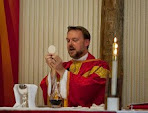
Sunday, April 4, 2010

Homily for The Feast of the Resurrection of Our Lord (Easter Sunday)

(Audio)

In the Name of the Father and of the + Son and of the Holy Spirit.

The resurrection of Our Lord Jesus Christ changed everything.

Adam’s bones were cleansed in the holy blood of the Lamb. The veil covering the Presence of God was torn from top to bottom, from God to you – no longer is there a separation between God and man. The stone of sin that kept you entombed has been removed. The Greater Jonah has bounded from His three-day bed. The strong man has been bound by the Stronger-Than-He. The cherubim no longer bar the way to paradise. And the great dragon of old has been made a toothless lion.

The Day of Resurrection is the eternal Eighth Day on which the sun never sets. All of creation has been restored now while awaiting and groaning for a fulfillment in the not yet. When the Son of God died on Friday it was finished. There was, and is, no more to do. Justification for the sins of the entire world is complete. Do you believe this? If you do, thanks be to God for this gift of faith! If you do not, repent, receive, and believe while there is yet time.

In His death, Jesus crushed the serpent’s head and Death was overcome by death. The wood of the Second Isaac’s sacrificial pyre has become for you a Greater Tree of Life with healing leaves and life-giving fruit in overflowing abundance. The Father has sacrificed His only-begotten Son for you. There was no ram caught in the thicket to offer as a substitute for Him, but He was the Ram caught in a thicket of nails, thorns, and whips, willingly laying down His life in love for your sins and for the sins of the entire world.

He died. He rose. He lives, today and forever. You are baptized into His death and resurrection: His death was your death. His resurrection is your resurrection. In this you have been sealed, anointed, with God’s own Name, promise, and Spirit; nothing can separate you from the love of God which is in Christ Jesus.

The strife is over, the battle won, but the old evil foe is still bent on the destruction of those whom God loves in Jesus. He is a liar and the father of lies. He tells you that Jesus did not rise again. He tells you that Jesus did not die for you, that you are not worthy, or that you are beyond the scope of salvation. But, lies are his only weapons, the lion has no teeth. Nevertheless, he will find much prey, and what a sorrowful tragedy that is.

Eat Jesus’ body, drink Jesus’ blood, and do this in remembrance of His death and resurrection: Christ has died. Christ is risen. Christ will come again. Do not fall prey to the devil’s lies. Love your neighbor that they may not fall prey to the devil’s lies as Christ has loved you today and always unto eternity.

He is risen! He is risen indeed! Alleluia!

In the + Name of our Victorious Lord and Savior Jesus Christ.

Homily for Holy Saturday – Easter Vigil

(Audio)

In the Name of the Father and of the + Son and of the Holy Spirit.

In the beginning…. When someone utters a statement that begins with words “In the beginning…,” you know you’re talking either to a theologian or a philosopher, or perhaps even a lunatic. Those words indicate that the speaker is about to make an absolute statement, something that they believe to be true even if they could never be prove it using empirical data or scientific method, even if contradictory evidence exists. In essence, they’re making a statement of faith, even a creed. And that is exactly how the sacred Scriptures begin, “In the beginning, God….”

And, the first thing that God reveals of Himself in the beginning is that He is a maker, a creator. This is remarkable, for to make something, to create something, is to put some amount of yourself into that which you make. And, the created, for as long as it exists, bears the mark of the Creator. It is remarkable that God should have created at all, but this He has revealed of Himself that to make, to create, to give life to another is an essential quality of God in His innermost being.

In the beginning, God created the heavens and the earth by speaking, by His Word gone forth from His mouth. And, the Word of God does not return to Him void, but it accomplishes that for which it was sent. In this way did God make all things that have been made, by His Word, in six days: sun, moon, and stars, the birds, fish, and animals, the trees, and everything else. And then, remarkable, God made a man, not by His Word as with everything else, but with His hands from the dust and dirt of the earth. God made a man in His image and breathed into the man His own living breath, and the man became a living creature. And from the flesh of the man God formed a woman and He brought her to the man. God blessed the man and His wife with the blessing that they would be makers, creators, life-givers like Him: “Be fruitful and multiply and fill the earth.” And on the seventh day God rested from all His work of creation, and God blessed the seventh day.

God is a maker, a creator, a life-giver – this first self-revelation of God is most important, for it helps us to better understand the incomprehensible and boundless love, grace, and mercy that also are essential qualities of His innermost being. We know how it went with our first parents in the garden. Infinitesimally more amazing than their rebellion against their Creator is God’s plan of salvation, that He would save man at all, let alone at the self-sacrifice of His Son. Before their fall He knew what He would do. In a moment’s vision to the “I AM”, but over hundreds of generations of mankind, God was creating anew, re-creating His fallen, broken creation. Why in this way? Why so long? These are imponderable questions from man’s perspective, but suffice it to say that this, too, is a revelation of God’s essential quality in His innermost being. He will not force Himself on anyone, but loves men that they might love Him in return. He gives life to dead and dying men that they might receive it from Him once again.

The flood was a mighty example, not of God’s silence, but of God’s mercy towards man. He cried out to the world drowning in sin and death that there was another way. He cried out “Stop going down the path you are going, the path that leads only to death”, and His life-giving Word cried out “Turn around and live!” The waters He utilized in creation He would now utilize in re-creation, washing away all sin and corruption while lifting up in salvation those who hearkened to His voice.

Similarly did God demonstrate to His people that He would save them, provide for them, and protect them, ushering His people out of the house of bondage in Egypt, passing them through the Red Sea, while destroying those who refused to repent and live in that same life-giving water.

The valley of dry bones combines themes of God’s creation of man with those of the resurrection of the dead, both occurring by the life-giving breath of God. These were the bones of God’s people that once were covered with flesh and tendons, but now were dead, dried out bones. Along the way the people of God turned from faith and lost hope; they cut themselves off from the life-giving breath and spirit-filled water of God.

In Jonah, God gives us a prophetic type of His plan of salvation. God told Jonah to preach to the Ninevites that they might repent and be saved. Because Jonah disobeyed God and fled, God brought both judgment and salvation upon Jonah when he was swallowed by the great fish. The three days Jonah spent in the belly of the great fish are a type of the three days Jesus spent in the heart of the earth. Jesus was judged in the place of Jonah and in the place of all men, and He arose triumphant from the grave to release all us would-be-Jonahs from sin, death, and the grave. And, once again God used water as an instrument of judgment and salvation. Jonah was thrown into the water in judgment to drown, but he was swallowed by a creature of the water and was saved.

Not only does God continue to call men to repentance and faith, but those who receive Him He marks and seals and protects. The baptismal imagery in the readings you have heard this evening are no coincidence, God continually uses His life-giving Word, water, and Spirit to mark and to seal His people. In renewing your baptismal vows, you are not unlike Shadrach, Meshach, and Abednego, refusing to bow down to false gods and idols, renouncing the devil and all his works and ways. So doing does not endear you to this world whose prince is the devil who will hurl many fiery darts at you. But like those three faithful Israelites, you know that you are baptized into Jesus’ death and resurrection and that nothing, not even death, can separate you from God the Father’s love.

In the beginning, God created the heavens and the earth. In six days God made the universe and everything in it, and on the seventh day He rested. When Adam’s rebellion plunged the world into sin and death, God set about restoring His fallen creation. The last thing He had to do was to redeem mankind from sin and death. God the Father sacrificed His only-begotten Son for the life of the world. God the Son willingly laid down His life in love. When He died on Good Friday, all that was required for the redemption of mankind was completed, it was finished. Having finished God’s work of re-creation and redemption, Jesus rested from His labors on the seventh day. Jesus rose from the dead on the day we call the first day of the week, Sunday, but from God’s perspective, it was the eighth day, the culmination of the seven that went before it. The sun never sets on the eighth day, it is eternity, for Jesus, and for all who are baptized into His death and resurrection. The sun has set, that day is now. This is the day that the Lord has made; let us rejoice and be glad in it.

In the + Name of Jesus. Amen.

Saturday, April 3, 2010

Good Friday Homily

Isaiah 52:13 – 53:12   (Audio)

In the Name of the Father and of the + Son and of the Holy Spirit.

Christian artistry, from iconography to stained glass, from statuary to jewelry, has long been a teacher of the Church’s faith and a preserver of that faith throughout the centuries from generation to generation. I personally enjoy going to the Metropolitan Museum of Art or to St. Patrick’s Cathedral or to any number of churches, seminaries, and museums to observe how a sacred artist has painstakingly crafted the tiniest of details into his work to capture the theological confession of a biblical story, or a scene from the life of Jesus, or a sublime truth about the nature of God and man. Christian musicians, likewise, have been known to do the same in their compositions as many of the visual artists. Johann Sebastian Bach, for example, placed a rhythmic emphasis on the third, off-beat eighth in each bar of his Pentecost chorale “Come, Holy Ghost, Creator Blest” emphasizing the Third Person of the Holy Trinity. The precise attention to detail in such artistic works is the artist’s confession of the faith that they have received which they have in turn gifted to the Church of Christ in works of sacred art.

One of my favorite sacred works of art, typically found in iconography and jewelry, is the Trinitarian Crucifix. This crucifix features the crucified corpus, or body, of our Lord Jesus on the cross. What is unique about the Trinitarian Crucifix, however is that a figure of God the Father is typically depicted as holding up His Son upon the cross with God the Holy Spirit, in the form of a dove, descending upon the Son from the Father. What is conveyed in this depiction is that Jesus’ crucifixion and death is the work of the entire Holy Trinity. God the Father sent His Son to die. God the Son obeyed the Father and willingly laid down His life. God the Holy Spirit is sent forth by the Father and the Son to birth the Church. The Church has at all times and in all places confessed that when any one Person of the Holy Trinity is acting, the entire Holy Trinity is acting. As the Son of God died on the cross, so God died on the cross for the sins of the world.

A similar depiction appears on the bulletin cover in your hand. As Jesus’ crucified body hangs upon the cross, we see four simultaneous actions taking place. The left hand of the Father bears the sacrificial knife that would slay His Son even while the Father holds in His right hand the crown of victory that He will place upon Jesus’ head. Also, a hand above Jesus’ head holds the key that unlocks heaven because of Jesus’ sacrificial death, while a hand at Jesus’ feet brings a hammer down upon a skull depicting that Jesus, in His death, destroyed the power of death that enslaved Adam and all his descendants. Indeed, a picture says a thousand words.

Images such as these serve to remind us that it was the Father’s will to crush Jesus. He who spared Abraham’s only-begotten son did not withhold the knife and the fire from His own only-begotten Son. The Father wounded and crushed Jesus for our iniquities so that by His stripes we are healed. Jesus, Himself, acknowledged that this was so in His testimony before Pilate saying that Pilate’s authority to crucify Him was given him by Jesus’ Father in heaven. The Father said “Go, my Son,” the Son replied “Your will be done, my Father.” He was led, like a lamb to the slaughter, and He opened not His mouth. As there is Unity in Trinity, so there is Trinity in Unity.

For, the will of God is one, shared by the Father and the Son and the Holy Spirit. Where the first Adam chose to follow his own will and plunged the world into sin and death, the Second Adam subordinated His will to the will of His Father, saying “Not as I will, but as You will.” And this is love, and obedience, and honor, all wrapped up into one commandment and one will of the Holy Trinity, love. God is love. The Son of God loved the Father perfectly, subordinating Himself to His will, obeying His commands; and the Son of God loved you perfectly, laying down His life in death for the life of the world.

Therefore, as the preacher to the Hebrews proclaims, Jesus is our Great High Priest, the anointed intercessor between God and man, and He offers up the perfect sacrifice, not of the blood of bulls and goats, but of His own sinless and holy blood. He is our priest and He is also the sacrificial victim. God the Father willed His Son to die. God the Son willingly laid down His life in death. And the God the Holy Spirit was breathed out by the Father, through the Son, for the life of the world.

Underneath the wounds and the stripes and the agonizing cries of Good Friday, God’s will is being done for us on earth as it is in heaven. God’s will for us is that we shall not die, but live, and declare the works of the Lord. No greater work can be done for us than Jesus Christ dying on the cross. The debt of sin is consummated today for you. Believe it for the sake of Jesus Christ, the Lamb of God Who takes away the sin of the world.

In the + Name of Jesus. Amen.

Thursday, April 1, 2010

A New Commandment

Holy (Maundy) Thursday        John 13:1-15, 34-35

(Audio)

In the Name of the Father and of the + Son and of the Holy Spirit.

The New Commandment that our Lord gives tonight is really the same as the Old, “Love,” the difference being, of course, that the New Commandment is the Old fulfilled in Jesus Christ. Our Lord Jesus fulfilled the commandment to Love – to love God with all your heart, soul, and mind; to love your neighbor as your self – when He laid down His life in love and died for the life of the world. Greater love is not possible than that one should lay down His life for His friends, not to mention His enemies.

And, in so doing, Jesus makes all things new. He takes the Old Commandment, the Old Covenant, and He fulfills them, then He transforms them into something new. The Old Commandment to love demanded perfection; it demanded complete, total, unconditional, perfect and holy love, always, in thought, word, and deed. That is to say that the Old Commandment kept us in bondage to sin and death because it always showed us our sins and how we did not keep it. But Jesus kept it for us. Jesus loved the Father perfectly and unconditionally, always; and Jesus loves you perfectly and unconditionally, always, even sacrificing Himself unto death and giving you His life.

So, the New Commandment that Jesus gives is a life-giving and liberating commandment; it is filled with, and it flows from, Jesus’ own love for God and for the world. Jesus loves you with this love and in so doing He has filled you to overflowing with His Divine Love so that it is with the Love of Jesus that you love one another. If you receive Jesus’ love, then you are tapped into an ever-swelling spring of living water; you will never thirst for love and you will always have limitless love to give. For, giving is what Jesus’ love does. Love gives to others, love serves others, not the self, just as Love Incarnate removed His outer garment, tied a towel around His waist, stooped down and washed the filthy feet of His disciples. He had always loved them, loving even those who hated Him, now He loved them to the end.

This is the night before Jesus’ crucifixion and death; this is the night of Jesus’ betrayal at the hands and lips of Judas. Our King who entered Jerusalem on Palm Sunday to shouts of praise will ascend His throne on the Friday we call Good and He will be named and crowned our King. But tonight He reveals what His Kingship looks like and of what quality His kingdom consists. The very Word of creation bows down to scrub His creatures’ feet. The eternal, only-begotten Son of God, humbles Himself to serve. The King of the Universe displays what true love is by thinking nothing of Himself, but only of others. Jesus has always been the King of the Jews, but His people wanted a different kind of king, another Saul or another David; tonight King Jesus fulfills those imperfect types and makes Kingship something new.

Jesus takes the bread and wine of the Old Covenant, and, having fulfilled them, He makes the Passover into something new: “This is my body which is for you. This cup is the new covenant in my blood, shed for you for the forgiveness of sins.”

And so we welcome Him yet again tonight as He comes to us in His holy meal, a king with a bowl and a towel, ready to wash us, to serve us; a king with a feast of His own body and blood, ready to nourish us; a king who is a lamb, slain in our stead that death might finally and forever pass over us. This is our Jesus who loves us, His own, to the end, with a love that never ends. Tomorrow we will stand in awe before that love as it shines forth in glory upon the cross; and the day after that we will shout for joy in that love as it breaks forth from the tomb.

Who could ever have dreamed of love so amazing, so divine? Glory to You, O Lord Jesus! Glory to You, our Lamb, and glory to Your holy blood forever! Amen.

Sunday, March 28, 2010

King Jesus

Palmarum

(Audio)

St. Matthew 26:1 – 27:66

In the Name of the Father and of the + Son and of the Holy Spirit.

Palmarum is both the Second Sunday of Passiontide and the beginning of the holiest week of the Church’s Year of Grace. The liturgy and the Propers for Palmarum are steeped in drama and passion. Even the most stoic of Lutherans may be seen this day to divert their eyes, to wriggle uncomfortably in their seats, maybe even to shed a tear or two. You cannot help but get caught up in the emotion of the day, for it brings together the entire Passion of Our Lord Jesus Christ in one setting.

When Jesus entered into Jerusalem on the first day of the week that would end with His trial, scourging, crucifixion, death, and burial, the crowds gathered in the City of God’s Peace for the Passover received Him with joyous, triumphal acclamation and praise, “Hosanna to the Son of David! Blessed is He who comes in the Name of the Lord!” They threw down their garments and palm branches before their Messiah King who would release them from their oppression under the Romans, retake the kingly throne of David, and restore glory and honor to Israel before the eyes of the Gentiles.

But, this was not the first time that they tried to make Jesus their king. When He fed the 5,000 plus with five loaves of bread and two small fish, and the people ate until they were full, and still they took up twelve basketfuls of leftovers, the mob rushed at Jesus to force Him to be their king. Jesus retreated up the mountain to be alone. But, the next day the mob found Him in Capernaum, and there Jesus taught them that they sought Him to be their king for all the wrong reasons. “Truly, truly, I say to you, you are seeking me, not because you saw signs, but because you ate your fill of the loaves. Do not labor for the food that perishes, but for the food that endures to eternal life, which the Son of Man will give to you.” Jesus then taught them that the True Bread that gives True Life is His flesh come down from heaven. Then the mob began to grumble.

How quickly the songs of praise turn to angry shouts and hatred. Palm Sunday begins with the joyful “Hosanna to the Son of David! Blessed is He that comes in the Name of the Lord” and it ends with ugly shouts of “Crucify Him! Crucify Him!” Jesus was indeed the King of the Jews, and of the Gentiles, – the sentence nailed over His gory head was correct – but He was not the kind of king the mob wanted. He rides into the capital City of God’s Peace, not on a war horse with a chariot, but lowly, in humility, on the colt of a donkey. He wears no royal gown of costly purple, but He is stripped of all clothing, scourged until His flesh is ripped and torn and He is robed in His own blood. Only then, and in cruel mockery, is He robed in purple cloth. His crown is also a mockery, a twisted ring of terrible thorns beat into His skull. To the eyes of the Jews and the Gentiles, to the eyes of the Sanhedrin, the Romans, and even to the eyes of the disciples, King Jesus was weak, pathetic, pitiable, and defeated. Change the sentence to “This man said I am King of the Jews,” the chief priests shouted. But Pontius Pilate, the sword of authority in God’s left hand, ruled “What I have written, I have written.”

Dearly beloved people of God, having eyes, you do not see. Having ears, you do not hear. There is only one Law of God, and that is love. Love is the fulfilling of the Law because love is always concerned with the welfare of another, not with the welfare of the self. How do you love God with all your heart, soul, and mind? You begin by not loving yourself more than Him. How do you love others? You begin by not loving yourself more than others. God is love, and this is how God loves, He gives, He doesn’t take, and what He gives is a free and perfect gift, the most costly and most precious gift possible, the gift of His Son in death for the life of the world. He gives the Life-Giving Bread from Heaven that men may eat and live forever, yet we grumble and complain and disbelieve because the gift doesn’t come in the fashion we desire. We are like children screaming “There’s nothing to eat!” standing before a pantry full of food!

Oh, we have eyes that see and ears that hear, but we allow them to be filled by the lies and deceptions of the devil because they fulfill our emotional needs, for a while. But, like eating a bag of fatty chips or a half-gallon of ice cream, what the devil gives us always leaves us feeling worse in the end, fat, lethargic, depressed, no energy, self-loathing, etc. Oh, we make for ourselves so very many kings, but none of them satisfies, and none of them frees us from the bondage of sin and death.

But, o people of God, you have a True King in Jesus Christ, God’s Son. King Jesus rules the people of His kingdom by serving them. King Jesus has served you by taking on your human flesh, by humbling himself, by becoming obedient to the authority of an earthly king even unto the point of death on a cross, because King Jesus is the sacrificial love of the Father for you His beloved sons and daughters that you may live with Him in His kingdom forever.

Your King who serves, your King who suffered and died for your sake to set you free from sin and death, your King Jesus, your Bread King, continues to serve you still. This day He stoops down from His throne to wash you anew in His absolution, restoring you to the purity of your Holy Baptism. This day He proclaims to you again His victory over sin, death, and the devil in His creative and life-giving Word. And this day He feeds you, still, with the Bread come down from Heaven, His holy flesh and precious blood, in this Blessed Sacrament that your flesh may be joined in His flesh and that your blood may be joined in His blood, O, most Holy Communion, that you may have the forgiveness of sins, eternal life, and salvation. Oh, what a King our Jesus is!

As I began to prepare for today’s service, at first I thought that it was going to be quite a challenge to work together the joy of Jesus’ triumphal entry into Jerusalem on Palm Sunday and the horrible shouts of “Crucify Him! Crucify Him!” on Good Friday, all on a day in which we also joyously celebrate that fourteen of our young catechumens will receive their First Holy Communion. But, as I prepared, I began to see that it is precisely Holy Communion that ties Palm Sunday and Good Friday together. Do we not sing the song of the Palm Sunday mob “Hosanna to the Son of David! Blessed is He who comes in the Name of the Lord” each and every time we celebrate the Holy Eucharist? Does not our King Jesus come to us humbly, mounted in, with, and under the common elements of bread and wine to serve us with the forgiveness, life, and salvation that He died on Good Friday’s cross to give us? And, does not our Lord Himself exhort us to eat and to drink His body and blood in remembrance of His Holy Passion and Blessed death?

Yes! The Lord’s Supper brings to you your King. “Rejoice greatly, O daughter of Zion! Shout aloud, O daughter of Jerusalem! Behold, your King is coming to you; righteous and having salvation is He, humble…” and hidden in lowly form, simple bread, inexpensive wine, He comes! He comes, and He is present, here and now for you, always for you. Once again King Jesus comes to you where you are and He serves you with His forgiveness, eternal life, and salvation. And where the King is, there is His Kingdom as well, with angels and archangels and with all the company of heaven. And at the Name of Jesus every knee bows, knees in heaven and knees on earth, even knees under the earth, and every tongue must confess that Jesus Christ is Lord. And, God the Father is glorified!

In the blessed and holy Name of + Jesus Christ, in whom the Father is glorified, with the Sanctifying Spirit of God. Amen.

Monday, March 22, 2010

A Matter of Birth

Judica – The Fifth Sunday in Lent  -  St. John 8:42-59

(Audio)

In the Name of the Father and of the + Son and of the Holy Spirit.

Judica Sunday receives its name from the first words of the historic Latin antiphon to the Introit for this day, “Judge me, O God.” Now, invoking God’s judgment upon one’s self is not something a poor, miserable sinner would want to do; that is, unless that poor, miserable sinner knew already that the judgment was going to be in his or her favor. Thankfully, this is the case with you today, for God has already judged in your favor by condemning His Son in your place; He has declared Jesus guilty, and you, you He has declared innocent. Our translation of today’s antiphon to the Introit captures this subtle difference and translates the word for “judge me” as “vindicate me.” – “Vindicate me, O God.”

God judges you righteous. He vindicates you of your sin-guilt on account of His Son. This means, of course, that you had absolutely nothing to do with your vindication. Let’s face it, you were guilty; even still you sin and you merit only guilt and death. But God has vindicated you on account of Jesus’ condemnation and death for your sins, past, present, and future. You did not pay off your debt to God by your good works. You did not impress Him with your faith and piety. You did not even choose to believe in Him. But He chose you. He sacrificed Himself for you. He satisfied the blood-guilt debt of your sin and He forgave you it. He judged you innocent, paying the debt Himself, thus you are vindicated.

Do you believe this? If you do, then God is your Father. If you do not, then your father is the devil, the father of lies. For, even in this age of test-tubes, fertility drugs, surrogates, and implants, the truth remains that everyone has a father. And you did not choose your father. You were begotten, wholly apart from your will and choosing. You did not choose how tall you would be. You did not choose the color of your eyes or of your skin. You did not choose any of those fleshly things. That which is born of the flesh is flesh; and that which is born of the flesh is guilty and condemned. That is why you must be born again of water and the Spirit. For that which is born of the Spirit is spirit. And you did not choose your Spiritual Father in your spiritual re-birth any more than you chose your fleshly father in your fleshly birth.

If God is your Father, then you will love Jesus, for Jesus was sent from the Father to be judged in your place. And Jesus has been judged, sentenced, and killed for your sin-guilt. He, who knew no sin, was made to be sin for us, that, through Him, we might become the righteousness of God. But before the words of Psalm 43 are ours, those words are Jesus’ words. “Vindicate Me, O God, and defend my cause against an ungodly people, from the deceitful and unjust man deliver me!” cries Jesus. And Jesus was vindicated by the Father through His death on the cross, because He was innocent and blameless. The guilt for which He died was not His own, nevertheless, that guilt died with Him and it is gone, dead, and buried. Thus, your vindication from sin-guilt and death is because of, and in, Jesus’ vindication. Therefore, if God is your Father, then you will love Jesus, for Jesus was sent from the Father to be judged in your place. Jesus has been judged; Jesus has been vindicated – and the whole world in Him.

Some scribes and Pharisees of the Jews claimed to have God as their Father. Jesus said to them, “If God were your Father, you would love me, for I came from God and I am here.” But the scribes and the Pharisees did not love Jesus and they did not believe that He came from God but thought that He was a demon-possessed liar. Jesus said to them, “You are of your father the devil, and your will is to do your father’s desires.” What you believe about Jesus is living proof of who your father is. Only those born of the Holy Spirit of God believe Jesus, love Jesus, and are therefore vindicated in Jesus. It’s not a matter of choice, but a matter of birth. Jesus asks, “If I tell the truth, why do you not believe Me?” and then He explains, “Whoever is of God hears the words of God. The reason why you do not hear them is that you are not of God.”

Mercifully, not being of God is a reversible condition. Repent, that is, be turned by the Holy Spirit of God. Stop obeying the lies and the will of your father the devil and listen to the truth of God. If you are not baptized, be born again of water and Spirit. If you are baptized, be restored to your baptismal purity. That which is born of the flesh is flesh and that which is born of the Spirit is spirit.

For God is a Father unlike Abraham, sacrificing His only begotten Son, not under compulsion, but out of love for you. And Jesus is a Son unlike Isaac whose life was spared, but who willingly laid Himself down upon the cross for you. And Jesus is a High Priest unlike any other high priest, offering up the atoning sacrifice, not of the blood of goats and calves, but of His own blood, thus securing an eternal redemption. And the Holy Spirit is the Lord and Giver of true life, sent forth by the Father and the Son to create faith and to draw back in repentance those who have been turned by the devil on the road that leads to death and hell that those who are called may receive the promised eternal inheritance.

Again today we get to receive this promise of an eternal inheritance. Our Great High Priest Christ Jesus delivers it to us at this Table. Here the sacrifice our Lord freely and willingly once made upon the cross is given to us as our life. These holy gifts free us from seeking our own glory and unite us to our Lord that, with and in Him, we may always seek only the honor of the Father, who with the Son and the All-Holy Spirit lives and reigns forever and ever!

In Jesus + Name. Amen.

Sunday, March 14, 2010

Daily Bread

Laetare – The Fourth Sunday in Lent

John 6:1-15    (Audio)

In the Name of the Father and of the + Son and of the Holy Spirit.

“The Lord is my Shepherd, I shall not want.” Most of us can’t even imagine what that must be like, to not want, to lack no-thing, to be fully and completely satisfied, fulfilled and complete.

For, in our lives we want for much. We are a hungry people: hungry for food, hungry for meaning and purpose, hungry for love, hungry for justice, hungry for forgiveness. We spend our lives searching for these things, craving these things, and finding them, temporarily, but often in the wrong people, the wrong places, and the wrong things. Bruce Springsteen was right, “Everybody’s got a hungry heart,” but like Bono sings, we “still haven’t found what [we’re] looking for,” so, like Mick Jagger, we “can’t get no satisfaction.”

Jesus knows this about you. He has compassion for you. He says to you, “You shall not want.” He gives you all that you need and more for your body and your life now, and in the life to come. His grace is sufficient for you. However, in our lives, sufficiency is usually not want we want; we think that we need more than we have, and we want more than we need. But God’s grace in Jesus Christ is sufficient, and it is all and more than we need.

Jesus gives us daily bread. Daily bread includes everything that has to do with the support and needs of the body, such as food, drink, clothing, shoes, house, home, land, animals, money, goods, a devout husband or wife, devout children, devout workers, devout and faithful rulers, good government, good weather, peace, health, self-control, good reputation, good friends, faithful neighbors, and the like. God gives this daily bread to all people, even those who hate Him, but we pray that God would lead us to realize this and to receive our daily bread with thanksgiving. All this He lovingly provides us out of fatherly, divine goodness and mercy, without any merit or worthiness in us.

And we grumble. O, we of little faith, how we grumble. We look the gift horse in the mouth and we grumble that we do not have enough. We grumble that what we have is not what we want. So we labor and we struggle to earn our daily bread, believing that it is by our works and our striving that we are fed and clothed and sheltered and that these things are constitutes life. What poor and pitiable people we are; what a poor and pitiable Church we are. The truth is that we are poor, wretched, beggars. What meager offerings we present before the Lord: two fish and five loaves, not enough for a crumb apiece. On our own, by our own devices, we are hopeless and lost.

But we are not on our own. We have never been on our own. With thanksgiving, Jesus takes our meager provisions and provides satisfaction, what we need, and more. There is no need to gather or to hoard, to look upon others with jealousy, for with Jesus there is no need, no want. Jesus is our daily bread, our Bread of Life, our bread king. The one who comes to Him shall never hunger; the one who believes in Him shall never thirst. He provides for all your needs of body and soul, and His mercies are new each and every morning. That’s the first lesson for today.

There is a second lesson, it has to do with the leftovers, for the Bread of Life always gives more than we need. The lesson is this: give it away. Give it away! Even if you think that you don’t have enough, give it away. You deceive yourself. Give it away, even then. For in the giving you lighten your load that you might keep on receiving. “Give, and it will be given to you. Good measure, pressed down, shaken together, running over, will be put into your lap. For with the measure you use it will be measured back to you." When the Israelites tried to hoard the manna it bred worms and stank. The widow’s oil and meal was never exhausted throughout the prophet’s stay. Use what is given to you, for you and your family, it is a gift of God’s grace in Jesus Christ and it is sufficient for you for today. Give the rest of it away, and do not worry about tomorrow, God will provide you tomorrow’s bread tomorrow.

And a third lesson is this: The Bread of Life is present now to satisfy your hunger and thirst with His body and blood. Each Lord’s Day He takes much less than five loaves and two small fish and He satisfies all His people with His immeasurable gifts of forgiveness, everlasting life and salvation. Take and eat, you shall not want. Take and drink, your cup runneth over.

In the + Name of Jesus. Amen.

Tuesday, March 9, 2010

Two Poems On Loss and Synthesis

[After great pain, a formal feeling comes –]

After great pain, a formal feeling comes–
The Nerves sit ceremonious, like Tombs–
The stiff Heart questions was it He, that bore,
And Yesterday, or Centuries before?

The Feet, mechanical, go round–
Of Ground, or Air, or Ought–
A Wooden way
Regardless grown,
A Quartz contentment, like a stone–

This is the Hour of Lead–
Remembered, if outlived,
As Freezing Persons recollect the Snow–
First–Chill–then Stupor–then the letting go–

Emily Dickinson, ca. 1862


Break, Break, Break

Break, break, break,
On thy cold gray stones, O Sea!
And I would that my tongue could utter
The thoughts that arise in me.

O, well for the fisherman’s boy,
That he shouts with his sister at play!
O, well for the sailor lad,
That he sings in his boat on the bay!

And the stately ships go on
To their haven under the hill;
But O for the touch of a vanished hand,
And the sound of a voice that is still!

Break, break, break,
At the foot of thy crags, O Sea!
But the tender grace of a day that is dead
Will never come back to me.

Alfred, Lord Tennyson, ca. 1834

Sunday, March 7, 2010

Liar, Lunatic, or Lord?

Oculi – The Third Sunday in Lent 7 March 2010

Luke 11:14-28   (Audio)

In the Name of the Father and of the + Son and of the Holy Spirit.

As Jesus was about to set His face to go to Jerusalem to suffer and to die for the sins of the world He asked His disciples, “Who do people say that I am?” They responded with a myriad of answers ranging from John the Baptist, to Elijah, to one of the prophets. Then Jesus asked them, “What about you? Who do you say that I am?” Peter replied, “You are the Christ (the Anointed One), the Son of the Living God.”

In his classic apologetic for the Christian faith Mere Christianity C. S. Lewis tackled this important question, “Who is Jesus?” Lewis wrote that there are three possible answers to the question – Either, Jesus is a liar, or He is a lunatic, or He is who He says He is and He is telling the truth.

This question, “Who is Jesus?” is part of what is going on in the first part of today’s Gospel Lesson from St. Luke. Jesus had cast out a demon from a man that had kept the man from speaking. The crowd watching was amazed and they marveled at this miracle. But then the questions came, “Who is this Jesus?” “From where does He get His power?” Some accused Him of casting out demons by the power of Satan. Others demanded that He provide them a sign from heaven before they would believe Him. But Jesus Himself claimed that He cast out demons by the “finger of God”, the Holy Spirit. So, either Jesus is a demon possessed lunatic, or He is a liar, or He is who He says He is and He is telling the truth.

Isaiah prophesied “Woe to those who call evil good and good evil, who put darkness for light and light for darkness, who put bitter for sweet and sweet for bitter!” (Isaiah 5:20) The good work that Jesus performed in casting out an evil demon is called by some in the crowd an evil deed itself! But Jesus refutes this attack by stating that evil does not cast out evil, for a house divided against itself cannot stand. Yet, the second group also calls Jesus’ actions evil, demanding a sign to prove that He is not a liar. No, the demons flee at the command of the finger of God, for, in Jesus, the kingdom of God has come and is present.

The power of Satan is strong, and on our own we have no defense against him. But Jesus is stronger than Satan. He takes the devil’s armor of sin and death and destroys them from the inside out by the holy cross. He exorcizes and frees us by water and the Word. We were once darkness, but now we are light in Christ the Lord.

Oh what pitiable, half-hearted, milquetoast, fence-straddlers we are. We think we can have our cake and eat it too. We have had our demonic original sin cast out of us in the cleansing torrent of Holy Baptism. We renounced Satan and all his works and all his ways. The demons fled from that Holy Water, cast out, searching for dry and barren habitations. But how quickly the flood waters have receded and we have returned to our casual and unconcerned way of life, thinking that compromising your faith to avoid the worldly scorn of others does not matter. You think that a little sin won’t hurt? God doesn’t expect you to be perfect? You hear the Word of the Lord but you do not keep it. Often you act as if you cannot stand it. Do you believe that you are saved and you need not worry about the forces of evil, that you are freed from sin to keep on sinning?

The demon is gone, for now, but he will come back, and he will bring others, more evil than himself, with him next time. The only way to keep him out is to have the house of your soul occupied by the Holy Spirit, and the Holy Spirit does not and cannot abide with sin. “For you may be sure of this, that everyone who is sexually immoral or impure, or who is covetous (that is, an idolater), has no inheritance in the kingdom of Christ and God.” If you are not with the Lord, then you are against Him. There is no fence-straddling. There is no middle ground. You cannot be a little bit sinful or a little bit holy any more than a woman can be a little bit pregnant. Only blessed are those who hear the Word of the God and keep it.

For you, this is impossible, but for God all things are possible. Apart from the Holy Spirit, you are a sinner and you will continue to sin, you are not holy. But the Stronger Man Jesus Christ has defeated Satan for you and has stripped him of his strong armor. He has poured into you in the Baptismal flood and in faith the Holy Spirit. Though He will not share you with sin and devils, He will defend you from them. And when you sin He calls you to repent that you may be forgiven and restored in the innocent, shed blood of the One stronger than Satan, Jesus Christ. For, to keep the Word of God is to cling to it in the face of temptation, to trust in it in humble and contrite repentance, and to give thanks for it in love, and praise, and service.

Even now you are invited to keep God’s Word in Sabbath rest as He feeds you, forgives you, and strengthens you as you eat and drink the body and blood of the Word made flesh, Jesus Christ. Today, your Lord stands ready to forgive and renew you by the Spirit of God, the Spirit who drives out the demons as the finger of God and strengthens people for bold, uncompromising witness to Jesus Christ. He Himself wishes to take up residence within you through His Holy Body and Blood, once offered for you as that "fragrant and sweet-smelling sacrifice to God."

In the Name of + Jesus. Amen.

Sunday, February 28, 2010

Unconditional Faith

Reminiscere – The Second Sunday in Lent

Matthew 15:21-28; Genesis 32:22-32    (Audio)

In the Name of the Father and of the + Son and of the Holy Spirit.

If we are to get straight to the point of what this day’s theme would teach us, then we must learn about faith. Now, faith can be a difficult thing to pin down. Thankfully, however, we do not need to turn to Webster’s or even Haley’s dictionaries, for Holy Scripture interprets itself and defines faith for us: “Faith is the assurance of things hoped for, the certainty of things unseen,” proclaims the preacher to his congregation of Hebrews. Now, in our common usage, I suspect few would include the words “assurance” and “certainty” in their definition of faith, and yet that is precisely the point the Scripture makes. Faith is neither blind nor irrational, as many suppose, even though it does not require verification according to the senses. Neither is faith weak, for it is not a thing in itself, but faith is unconditional trust in that which is absolutely and unswervingly true, the incarnate Word of God, Jesus Christ, who is Truth.

Moreover, faith is not choice that you make, nor is it a work that you do. You do not choose to believe, though you can refuse to believe. Neither do you make yourself to believe, though you can do things contrary to what you believe that will eventually lead you to unbelief. For faith is a gift of God’s grace so that, if you have faith, then thanks be to God for this precious gift, and, if you do not have faith, then there is something that you can do, stop thinking, saying, and doing the things that you are doing and repent, that is, be turned from the path that leads to death back to the God who desires to give you His life.

Further, faith is not quantifiable – you cannot measure it. If you have faith, then you have it, and if you do not, then you do not. Nevertheless, we can see faith in the words and the deeds of others, in their confession of faith. We can see those who have great faith, and perhaps surprisingly, quite often they are the ones suffering great affliction, tribulation, and distress. We marvel at them saying, “I don’t know how she does it!” “He’s a fighter, he just won’t give up.” And yet, we are not to attempt to measure the faith of others; we are not given to judge who has faith and who does not, or how much.

Faith is kind of like what they keep saying about gold in this recession that we’re in, “It’s never worth nothing.” However, while your $1,000 dollar investment in gold may at some time be worth only $100, your faith, no matter how small, is always worth eternal life and sonship in the kingdom of heaven. And so, the lesson is not about how much faith you have, but it is about what faith looks like and what faith believes, what your faith is in.

It is for this reason that Jacob is presented to us. Jacob was fleeing from his brother Esau who was coming after him with 400 men. Jacob sent his wives and his children, his servants, and all his possessions across the river to safety and he remained utterly alone, stripped of all comfort and support, to face his brother, whom Jacob believed sought to kill him.

Then, to make matters worse, the Scriptures tell us that a man wrestled with Jacob through the night until dawn. Jacob confesses that this man was none other than God Himself. Unable to overcome Jacob, the man who is God puts Jacob’s hip out of socket, but still Jacob will not let this God-man go until He blesses him.

And so, there is Jacob, standing alone in faithful trust that God will help him even as Esau approaches with his 400 men, only to have God Himself wrestle with him all night, exhausting his strength, and then causing him excruciating, crippling pain by putting his hip out of socket. What do you do when God Himself seems to be your enemy? What did Jacob do? Did he curse God? Did he accuse God of being unfair or evil? No, Jacob held onto God all the tighter, he refused to release Him until God blessed him. And God did bless him. God changed Jacob’s name to Israel, which means, “he who wrestles with God and prevails”.

For, such is faith – to wrestle with God and prevail – to not let go in unbelief, but to cling to Him no matter what, trusting that He is good and that He keeps His promises. Jacob surely thought that he would die, alone there in the wilderness with his brother and 400 men coming after him, then being exhausted and crippled by the God-man who wrestled with him all night long. Yet even in the face of near certain death, Jacob held on to God in faith. And, as it turns out, God being the master story-teller that He is, when Esau finally arrives with his 400 men, he embraces Jacob and has mercy on him, and the two brothers are reconciled. Even Esau’s anger against Jacob was an instrument of God’s testing of Jacob’s faith that Jacob’s faith might persevere and produce in him character and hope. For, the greatest blessing is God’s mercy shown to those who refuse to let go of Him in faith.

However, the lesson continues, and we are presented with another example of tenacious faith. This time the subject is not a patriarch of Israel, but a lowly and despised Canaanite woman. She cries out to Jesus for mercy upon her and her demon-possessed daughter, and Jesus ignores her. Still, she continues to cry out to Jesus. First, Jesus chides her saying that He was not sent to help people like her, but then He insults her, comparing her to a dog. Still, she will not let go of Him. What do you do when God seems to ignore your pleas and your prayers? You pray and you pray, still the cancer spreads, the miscarriage occurs, your loved one dies. Do you curse God? Do you rail at Him, “Where are you?!” Or do you cling to Him like this Canaanite woman, like Jacob, in faith, trusting that God is good and merciful and will work all things for the good of those who love Him?

The woman pleads with Jesus saying, “Yes, I am a dog. I am not worthy of the gift that I ask. But I know You; I know that You are good and merciful, gracious and kind, that You give to those who trust in You what they do not deserve. I will eat the crumbs of Your grace that fall from Your children’s’ table. For, even a crumb of Your mercy and grace, Your forgiveness and life, will satisfy me and make me whole.” Jesus replied to this woman, “Great is your faith! Be it done for you as you desire.” And her daughter was healed instantly. What does faith look like? This is what faith looks like, says Jesus.

Today’s lesson is about holding on to God in faith – no matter what – to plead with Him continually, incessantly, even when He seems not to be listening, even when He seems to reject your prayers. Even then you are to without ceasing. Because faith is a struggle. Faith is like Jacob who wrestled with God all night saying, “I won’t let you go until you bless me.” Faith is like the Canaanite woman who, even though she confessed that she was not worthy, would not let Jesus go without blessing her.” Faith is tenacious and resilient, and God will bless those who hold on to Him in faith no matter what the result might be. He will give you what you need to persevere, and, ultimately, to overcome. But God knows what we need, which is often quite different than what we think we need, and He supplies us all that we need to support our bodies and lives now, and into eternity.

Even now He provides for His children, hearing with ears of faith, seeing with eyes of faith, precious and holy crumbs fallen from the festal board of the Lamb in heaven. Faith is the certainty that this is the real and true body and blood of the God-man Jesus Christ given and shed for you; faith is the assurance that, in eating and drinking, your sins are forgiven just as Truth Incarnate has said. And when it seems like God has forgotten you, cry out to Him in faith, “Remember Your mercy, O Lord, and Your steadfast love… Let not my enemies exult over me. Redeem Israel (Your one who struggles), O God, out of all his troubles.”

In the Name of the Faithful One + Jesus Christ. Amen.