
John 2:1-11; Ephesians 5:22-33; Amos 9:11-15
In the Name of the Father and of the + Son and of the Holy Spirit.
It’s notable that in the Gospel account of Jesus’ first miracle, the changing of water into wine, the miracle itself seems almost of secondary importance. In fact, no one even realizes what has happened, save for Jesus and His disciples. Indeed, the miracle itself is not really the point, nor even the wedding, but rather that Jesus “manifested His glory” before His disciples, and they believed in Him.
John does not even call this a miracle, but a sign. This is the first of seven signs in John’s Gospel, and each one reveals who Jesus is and what He has come to do. These signs cannot be grasped by just anyone. They are not recognized by human wisdom or observation, but only by revelation. A person cannot see Christ’s glory unless it is given to be seen. In Christ, God has stepped into the world to establish a new kingdom and a new covenant.
The old stone water jars stood there as symbols of the old covenant. They were used for the purification rites of the Jews, who had to ceremonially wash themselves of uncleanness before participating in the rites and rituals according to the Law. Yet this washing was ultimately futile. No amount of water could wash away the stain of even a single sin. And once the jars were empty, they would simply be filled again, and again to the brim. What was needed was a new purification altogether, one that would not merely cover sin for a time and then need repeating, but one that would actually take sin away once and for all.
That is what the wine signifies: forgiveness for sins, holiness for the unrighteous, joy for sadness and despair, life for death. Though His hour had not yet come, the hour of His Passion when His glory would be fully revealed, Jesus grants this sign beforehand so that His disciples might believe in Him. In this quiet and almost unnoticed way, Jesus shows that He has come to fulfill the Law’s demands for us. He takes our uncleanness upon Himself and gives us, in exchange, His innocence, righteousness, and life.
This was no ordinary wine, but the best wine. For this wine points to the wine of Jesus’ blood poured out for us, and to His flesh given for the life of the world. The fullness of this revelation would be saved for His hour, when He would truly save the best for last. All the guests at the wedding drank of this wine, yet few knew from where it came. But those who did know, His disciples, were sustained by it as they were prepared to go forth and proclaim the Good News to all the world, even at the cost of their lives.
It was not only a wedding party that had run out of wine, but the children of Israel themselves. This was the condition of all humanity before Christ. The prophet Amos describes it as “the booth of David that is fallen,” a kingdom in ruins. Yet the LORD promises to repair its breaches, to raise up its ruins, and to rebuild it. Through Amos, the LORD speaks of restoration in this way: “The mountains shall drip sweet wine, and all the hills shall flow with it.” He promises to restore His people, to plant them on their land, never again to be uprooted. The redemption of God’s people is like the very best of wines.
This is the glory that would finally be revealed in Jesus when His hour came on a dark Friday afternoon more than two thousand years ago. Through the prophet Isaiah, the LORD had long promised, “On this mountain the LORD of hosts will make for all peoples a feast of rich food, a feast of well-aged wine… He will swallow up death forever; and the Lord GOD will wipe away tears from all faces.” That feast is still to come in its fullness, to be revealed on the Last Day, the Day of Christ’s return and the resurrection of the dead.
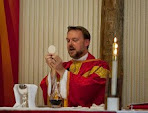
Yet even now, we already partake of a foretaste of that feast at this holy altar. Here the Lamb whom God has provided gives Himself to us to eat and to drink, His body and His blood, in remembrance of Him and all that He has said and done, and in communion with Him until He comes again.
Every feast has a bridegroom. And that is why this sign takes place at a wedding. Jesus’ first sign has everything to do with marriage after all. Jesus did not regard a wedding as something merely secular or worldly. If that were so, He would not have been there. Yet not only is Jesus present, but also His mother and His disciples. God Himself created man and woman and joined them together as one flesh, that they should be fruitful and multiply. This was God’s first blessing upon humanity.
Marriage is not an invention of man, nor merely a social arrangement, but a gift of God. Scripture offers no vision of human flourishing that runs contrary to marriage and the bearing of children. Celibacy, as St. Paul teaches, is a special calling and gift given to some, but marriage remains God’s good and gracious order for most.
And why marriage? Because marriage is given so that we might better understand, however imperfectly because of sin, the kind of love and relationship God desires to have with us. God does not merely desire to be our God; He desires to be our husband. The Church is His Bride. Yes, God desires to marry you, and more than that, to make you fruitful with His own life and love.
That is why the Church has long spoken of the Lord’s Supper as a foretaste of the marriage feast of the Lamb in His kingdom, which has no end. In this feast, we, the Bride of Christ, are joined as one flesh with our Bridegroom. His life becomes our life, and He makes us fruitful in love toward one another, all to the glory of His holy Name.
Like those first disciples at Cana, we know where this wine comes from.
Come, then, and join in Cana’s feast, until He comes.
In the + Name of Jesus. Amen.


No comments:
Post a Comment