
Luke 18:31-43; 2 Corinthians 13:1-13; 1 Samuel 16:1-13
In the Name of the Father and of the + Son and of the Holy Spirit.
One of the reasons our Lord taught in parables was, as He Himself says, that “seeing they may not see, and hearing they may not understand.” That is not because Jesus wished to confuse, but because no one truly sees without Spirit-given eyes, and no one truly hears without Spirit-given ears. A blind man cannot make himself see. A deaf man cannot make himself hear. Hard soil cannot soften itself, nor can rocky and thorny ground make itself fruitful. Only the Holy Spirit does this, where and when it pleases God, by grace alone, through the Word alone, received by faith alone.
This is precisely what we see in the blind man along the road to Jericho. He sat there begging because he was blind. He could not change his condition. He could not improve himself. He lived entirely by mercy. Yet though he was blind, he was not deaf. He could not see, but he could hear. Indeed, he could see with his ears.
Hearing the crowd pass by, he asked what it meant. They told him, “Jesus of Nazareth is passing by.” And that was enough. To him it was given to know the mysteries of the kingdom of God. The others saw only a traveling teacher. The blind man heard the presence of the Messiah.
Those walking ahead rebuked him and told him to be silent. They treated him as an annoyance, an interruption, an embarrassment. But like seed falling into good soil, the Word had already taken root. He cried out all the more: “Jesus, Son of David, have mercy on me!”
Notice what faith does. It does not remain polite. It does not yield to pressure. It clings. It insists. It cries out for mercy because it knows where mercy is found.
And Jesus stopped. “What do you want Me to do for you?” “Lord, let me recover my sight.” “Recover your sight; your faith has made you well.” Immediately he saw, and he followed Jesus, glorifying God. “Your faith has made you well.”
What does this mean? It means exactly what it says. Faith laid hold of Jesus and His Word. The man’s healing did not begin with his eyes but with his ears. Before he ever saw Jesus with bodily sight, he saw rightly by faith. He recognized what others missed: this was the Son of David, the promised Christ, the Lord of mercy. Faith makes well because faith clings to Jesus, and Jesus is forgiveness, life, and salvation.
Here is the great irony of the text: the blind man sees what the seeing do not, even the disciples. Just before this encounter, Jesus plainly tells them what awaits Him in Jerusalem: betrayal, mockery, suffering, death, and resurrection. Yet St. Luke tells us they understood none of these things. The meaning was hidden from them. They had eyes, but they did not yet see.
The blind man had no eyes, yet he saw truly. Why? Because faith does not rely on human reason or appearances. Faith trusts the Word of Christ, even when that Word contradicts expectation. A suffering Messiah? A crucified Lord? Salvation through death? These things remain hidden to natural sight.
And so it is also with the baptism of little Grace this morning. There is no clearer picture of our complete passivity before God than an infant brought to the font. Grace did not choose to be here. She did not decide for Christ. She cannot comprehend language. Others speak for her. And yet we believe, teach, and confess that in Baptism she receives exactly what God promises: forgiveness of sins, the gift of the Holy Spirit, rescue from death and the devil, and union with Christ. Why? Not because it fits human logic. Not because it satisfies reason. But because of the Word of God: “Let the little children come to Me.” “Whoever believes and is baptized will be saved.” “Baptism now saves you.”
Faith sees what eyes cannot. Faith hears what reason resists. Faith trusts what God declares. We must learn to see with our ears — to receive God’s gifts as He gives them, not as we would design them.
This is the lesson Samuel had to learn. Sent to anoint Israel’s next king, he naturally looked for stature, strength, and outward impressiveness. But the LORD corrected him: “Man looks on the outward appearance, but the LORD looks on the heart.” God’s ways consistently overturn human judgment.
The same correction appears in St. Paul’s teaching. Spectacular gifts, impressive abilities, outward displays of spirituality, these mean nothing without love. Apart from Christ’s love, even the most dazzling works are only noise.
Natural sight always misjudges. Human wisdom always misleads. Left to ourselves, we are the blind man. But here is the Gospel: the Lord has not left you to yourself. You are here because the Holy Spirit has given you ears to hear and eyes to see. He has called you by the Gospel, enlightened you with His gifts, sanctified and kept you in the true faith.
Yet the Christian life is not a moment but a pilgrimage. Faith must endure. Vision must be continually restored. The world, the flesh, and the devil never cease their attempts to silence the cry for mercy. And so our Lord’s question remains ever before us: “What do you want Me to do for you?” The faithful answer never changes: “Lord, have mercy.”
In a few days we begin again the holy season of Lent — a pilgrimage of repentance, of renewed hearing, of restored sight. We return because the Lord calls us to return. We return because He is gracious and merciful, slow to anger and abounding in steadfast love. We return because there is One who receives sinners.
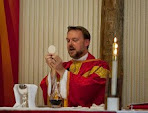
Like beggars along the roadside, we come with empty hands and persistent voices. And where does Jesus stop for us now? Where does He open blind eyes and forgive sins? Where does He give Himself to those who cry for mercy? Here. At His altar. For we are indeed going up to Jerusalem, not merely as history, but as present reality. The crucified and risen Lord reigns even now as our Prophet, Priest, and King. And here He does what faith alone can see and believe. Here He feeds His people with His own Body and Blood. Here mercy is not requested but given. Here sight is not restored to the eyes but to the soul.
So cry out with the blind man. Cling to the Word. Come as beggars. For the Son of David is passing by, and He stops to be merciful.
In the + Name of Jesus. Amen.


No comments:
Post a Comment